RMG Wage Protests: A Hard Test for Bangladesh's Economy
Garment workers' demand for a Tk 30,000 minimum wage entered its fourth day of protest on 3 November, with 306 factories halted and nearly 700,000 workers affected, according to BGMEA. This editorial analysis weighs the workers' case against factory owners' constraints and the export risks during the peak October–February order season.
Analysis
RMG Wage Protests: A Hard Test for Bangladesh's Economy
Garment workers' demand for a Tk 30,000 minimum wage has entered its fourth day of protest. According to BGMEA, 306 factories remain closed in this movement and nearly 700,000 workers have been affected. Factories staying shut during the October-to-February peak order season means not just lost income for workers, but a signal of deep crisis for the entire export-dependent economy.
The news says the protests have concentrated in the Gazipur and Ashulia industrial belts. The workers' demand — with the soaring cost of living, running a household on the current wage has become impossible. In their words, a Tk 30,000 minimum wage is now the demand of the time. The owners' counter-argument — order prices are falling in the global market, fuel and raw material costs are rising; a sudden large wage hike in this situation will push factories toward closure.
The workers' case: a question of survival
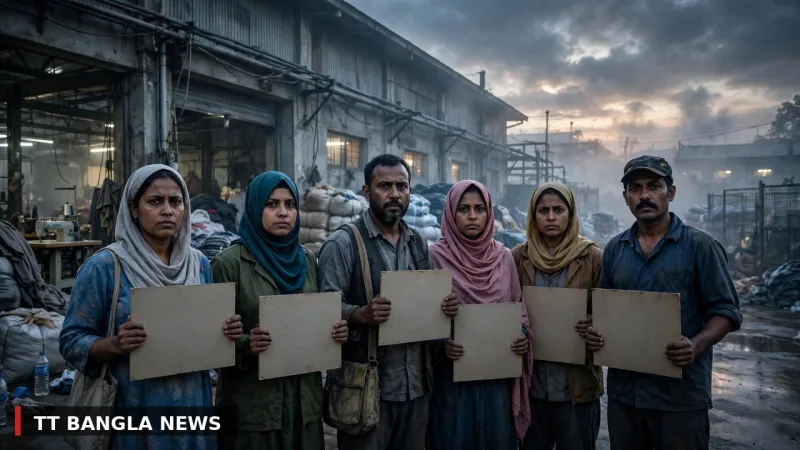
The way commodity prices have risen in recent years, a garment worker's monthly income is struggling to meet even the family's basic needs. House rent, food, medical care and children's education costs combined make survival difficult under the current wage structure. Labor leaders demand that the prolonged delay in implementing the wage board's recommendations is at the root of this discontent.
The protesters say they do not want work stoppages; they want fair wages. But many feel they have no path left open except taking to the streets to realize their demands. The news says protests have turned violent in some areas, with vehicle vandalism and clashes with police.
The owners' position: a fight for survival
BGMEA leaders say the apparel sector is going through a difficult time. Demand has fallen in European and American markets, and tough bargaining over order prices with buyers continues. Meanwhile fuel, gas and raw material prices have risen. In this situation, they fear that enforcing a Tk 30,000 minimum wage will make survival impossible for small and medium factories.
The owners further argue — to survive against competitor countries Vietnam, Cambodia and India, production costs must be kept under control. A sudden large wage hike will divert buyers to other countries, resulting in factory closures and rising unemployment. Their proposal — phased wage increases and joint initiatives to raise productivity.
Risk to the economy: unrest in peak season
The lion's share of Bangladesh's total export earnings comes from ready-made garments. October–February is the sector's peak order season — production during this period secures the bulk of the year's exports. 306 factories staying closed in this season means disrupted timely shipments, lost buyer confidence and the risk of future orders slipping away.
According to economists, prolonged unrest will hit foreign exchange earnings, with effects spilling over into the overall economy. Pressure on remittances on one side, a slump in exports on the other — if both happen together, macroeconomic stability will be threatened.
The government's role: expectation of mediation
In this three-way tug of war, the government's role is decisive. The news says the labor ministry has already started talks with both owners and workers. Demands are growing louder for reconstituting the wage board and swiftly formulating recommendations.
Analysts say merely raising wages will not solve the problem. What is needed — coordinated steps in rationing facilities, healthcare, housing and workers' skill development. Alongside, policy support to reduce factories' energy costs and diplomatic efforts to ensure fair prices from buyers are necessary.
The path to resolution: dialogue is the only way
History says lasting solutions to labor unrest do not come through conflict. Accepting workers' just demands and preserving owners' capacity to survive — a balance must be found between the two. A sustainable framework can be built through the combination of phased wage increases, productivity-based incentives and strengthened social protection.
The apparel sector is the backbone of Bangladesh's economy. If this backbone is hurt, the loss is not just the workers' or the owners' — it is the entire nation's. So all sides must sit at the dialogue table and quickly reach an acceptable solution. Delay means making the economy's hard test even harder.
Reader comments (0)
No comments have been published yet.